
Within my theology and Christology, there is definitely a place for the historical Jesus and the cultural context within which he lived, alongside the divine person of Christ Jesus who gifts us with salvation and eternal life and lives within us through his spirit. I’m not sure who the original explanation of this came from because I found it copied on many websites while researching the validity of the historical context. The context, by the way, is valid according to my research.
So, we realize Jesus, the man, was a reflection in many ways of the culture within which he was born and lived.
Jesus used the customs and culture of that time to teach with parables, to spread his message, and to prove his divinity and his return to earth again:
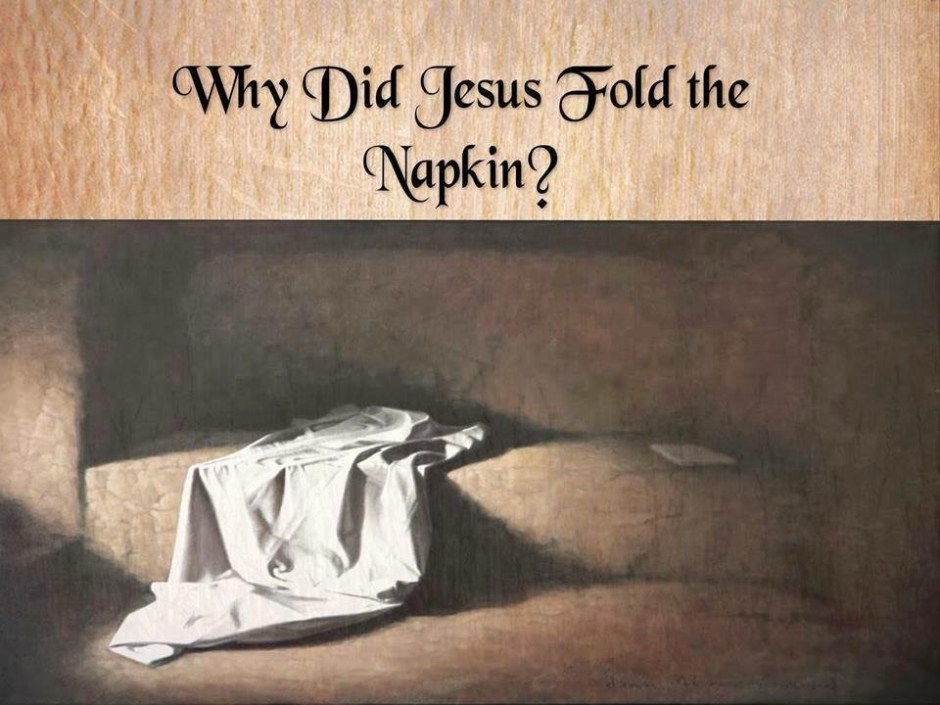
Why did Jesus fold the linen burial cloth after his resurrection? The Gospel of John (20:7) tells us that the napkin, which was placed over the face of Jesus, was not just thrown aside like the other grave clothes. The Bible takes an entire verse to tell us that the napkin was neatly folded, and was placed at the head of that stony coffin.
Early Sunday morning, while it was still dark, Mary Magdalene came to the tomb and found that the stone had been rolled away from the entrance.
She ran and found Simon Peter and the other disciple, the one whom Jesus loved. She said, “They have taken the Lord’s body out of the tomb, and I don’t know where they have put him!” Peter and the other disciple ran to the tomb to see. The other disciple outran Peter and got there first. He stooped and looked in and saw the linen cloth lying there, but he didn’t go in.
Then Simon Peter arrived and went inside. He also noticed the linen wrappings lying there, while the cloth that had covered Jesus’ head was folded up and lying to the side.
Was that important? Absolutely! Is it really significant? Yes!
In order to understand the significance of the folded napkin, we need to understand a little bit about Hebrew tradition of that day. The folded napkin had to do with the master and servant, and every Jewish boy knew this tradition. When the servant set the dinner table for the master, he made sure that it was exactly the way the master wanted it. The table was furnished perfectly, and then the servant would wait, just out of sight, until the master had finished eating.
The servant would not dare touch the table until the master was finished. Now if the master was finished eating, he would rise from the table, wipe his fingers and mouth, clean his beard, and wad up the napkin and toss it onto the table. The servant would then know to clear the table. For in those days, the wadded napkin meant, “I’m finished.”
But if the master got up from the table, folded his napkin and laid it beside his plate, the servant would not dare touch the table, because the folded napkin meant, “I’m coming back!”
Jesus left a thoughtful, intentional clue for people who would find the empty grave and little did they know they would see him again so soon. And one day we will, too.
Why is this important on my grief journey? My husband was saved by grace, as am I. Knowing I’ll see Jesus one day also means being reunited with the love of my lifetime here on earth. This story of the folded “napkin” gives me a reminder of the hope I have in Jesus and the assurance that my husband’s death was only a mortal one. He is alive in Jesus and waiting in the place God has prepared for me. That means that his death was not the end but that a new beginning awaits. In that, I find great comfort even as I grieve the changes I continue to face here. ♥️







 God is in the Outcome